Showing posts with label Latest. Show all posts

Tuesday, November 7, 2017

no image

Step Up Your Content Marketing Strategy with These 4 Insider Tips

[ad_1]


PHOTO CREDIT: Getty Images


With data showing that companies deemed content marketing leaders experience 7.8 times more site traffic than non-leaders, it's no big surprise that more brands than ever are getting on board. The question, though, is: How do you become a content marketing leader?


Last week, I went to Chicago to attend Orbit Media's ContentJam conference to look for an answer to that question. Experts in content marketing came from around the world to share their insights--and I've distilled some of the major takeaways I learned at the event below.


1. Don't be afraid to sell within your blog posts.


Joanna Wiebe, copywriter and co-founder of Airstory, pointed out that since the early 1900s, businesses have been making a sales pitch within written content--be it in a long-form sales letter or print ads.


She referenced the iconic sales piece by John Caples: "They laughed when I sat down at the piano, but when I started to play..." to show that modern blogging is not all that different from the marketing tactics of the 1920s.


Her overall message was simple: Don't be afraid to make a sales pitch within blog posts. If you're educating readers and providing a valuable lesson, it's a good idea to include a helpful solution (namely, your product) at the close of your piece--because they're primed and ready for it. It worked decades ago, and it still works today.


2. Viral content is shareable content.


Nadya Khoja, Marketing Manager at Venngage, shared her insight into how the company has regularly achieved virality with content. In her experience, shareability, relevance, and quality are the major components that contribute to whether or not a piece of content goes viral.


She went on to explain that relevancy comes with deeply understanding your audience--so that when you create something like an infographic, for example, the subject matter is both timely and interesting to the people you're targeting. If you don't truly understand the needs and wants of your demographic, content often falls flat.


3. Create content that stands the test of time.


Are you creating "evergreen" content? Aaron Orendorff of IconiContent says you should. Evergreen content is content that stands the test of time and that is still relevant months (years, even) after it's published.


These are typically posts that include elements like how-to lessons, original quotes from experts, original research, and step-by-step processes that hold up to the passage of time.


The reason evergreen content is so important: It gets linked to and referenced by other content creators--and it continues to deliver results on an on-going basis.


4. Don't let confirmation bias lead to false conclusions.


Unbounce is a company that knows about testing--and co-founder Michael Aagaard spent his stage time talking about the dark side of testing when it comes to content marketing: Confirmation bias.


Believing in false positives can lead to poor decision-making and lost sales, so he advocated for long-term tests and ongoing curiosity rather than quick results that ultimately fail over time. The bottom line: If you're split testing your website or marketing tactics, don't be fooled by quick wins.

The post Step Up Your Content Marketing Strategy with These 4 Insider Tips appeared first on inc-asean.com.


[ad_2]
no image

Boost Your Conversion Rates Today With These 3 Simple Tactics

[ad_1]


PHOTO CREDIT: Getty Images


While there are still 2 months left of 2017, now is the time most marketers start planning ways to boost business in the new year. This usually comes with a focus on new initiatives, a review of current content trends worth exploring, and abundant keyword research. In other words, as marketers we often focus on growing business by growing new content, but this can easily distract from making improvements to our current channels.


Conversion rate optimization can sometimes feel unnatural for busy marketers because it requires us to pause and improve what currently exists rather than race towards the always moving finish line of new content development. But if even a few simple tweaks boost your conversion rate by a full percentage point, how much revenue would that drive? And what if there were multiple ways to grow that conversion even further? Here are 3 proven tactics to boost your conversion rates by leaps and bounds:


Ditch Stock Imagery


For years, on-site hero images from quality stock photo providers were the best tool for improving lead funnels. When running A/B testing, companies will often test stock images as the primary variable before tweaking messaging and calls to action. But a study from PWC suggests that this no longer works. In fact, the study showed that custom designed images convert 7 times better than stock imagery!


Over the years, technological advancements have ensured that consumers can be catered to in almost all facets of their lives. This has made us pickier and more accustomed to original, quality products. We want authenticity, and stock imagery deters from this. By giving your audience what they want, you will earn their trust faster and improve your lead flow.


Lead With Video


Today's audiences are quick to admit that they don't have time to read your pitch, but according to a recent study from Animoto, 4 out of 5 people will eagerly watch a video about it. But like stock imagery, the video must be custom. In fact, videos that are cheaply produced or rely on stock assets are known to hurt conversion rates rather than help them. This is because they communicate a lack of commitment to quality or worse: a belief that the audience isn't smart enough to notice.


So rather than choose the cheap solution that could hurt your conversions, consider the return on investment that would come from leading with something custom instead. According to EyeView, a high-quality motion graphic has the power to increase your conversion rates by 80 percent!


Videos that drive the best conversion improvements include custom, animated videos and live-action videos with animation overlays. These videos are often less than 90-seconds in length, include a professional voiceover, and entirely unique illustration. Videos that tend to hinder conversions include talking head live-action clips, whiteboard animations, and animations using stock vector assets.


Drive Your Point Home With Infographics


Infographics don't just entail long-scroll images that act as link bait. They also come in the form of bite-sized content placed throughout your website to drive engagement and increase the understanding of your product or service.


Does your company have great statistics to share? Consider choosing the top 4 and placing them on your homepage as a mini infographic. Or maybe you have a complex process to explain. Rather than using paragraphs of text to drive your point home, a process illustration can visualize your message and improve comprehension.


Today's consumers avoid reading assignments and large walls of text. But eye tracking studies from the Nielson Norman Group show that they will spend the bulk of their time looking at information-carrying images on your site. To reduce bounce rates and drive people through your conversion funnel, time on-site is important. If you can lock a user in for 10-seconds, the likelihood of them staying on your site increases exponentially. By separating your on-site content with mini infographics and visual narratives, viewers will not feel as overwhelmed, increasing their engagement and growing your conversion rate.


Before you invest time building your content calendar for 2018, consider auditing your current conversion funnels to see what opportunities lay before you!

The post Boost Your Conversion Rates Today With These 3 Simple Tactics appeared first on inc-asean.com.


[ad_2]

Thursday, October 12, 2017

no image

Want Honest Advice? An Astronaut Taught Me the 3-Step Feedback Rule (and It’s the Only One That Works)

[ad_1]


PHOTO CREDIT: Getty Images


As a leader, I think it's really important to constantly surround yourself with good honest feedback from trusted people smarter than you. That's because, as I've said before, I'm always growing and learning and trying to be better.


I couldn't do that in a vacuum. I need a living, breathing, tough-love feedback loop to keep my leadership -- and my work -- thriving.


I once heard the astronaut Mark Kelly tell the most impactful story about sourcing information I've ever heard. He and I were at a conference where we were both speaking. Mark, as you know, is married to Gabby Giffords, the congresswoman who was shot in 2011.


Mark is someone I truly look up to -- I've always been awestruck by astronauts, having grown up with a dad who was in love with space and the stars.


As an astronaut, Mark recalled, you undergo severe training for stress and anxiety, so that you're prepared for whatever could possibly go wrong. In space, plenty can go wrong.


But the big crisis took place on Earth. His new wife had been shot, and at the hospital he had to help choose between two different treatments. One of the things he remembered under this extreme life stress was that it was important to make sure everyone in the room gave him their opinions.


As he said in his story, he started with the most junior person and asked, "What do you think we should do?"


He knew if he started with the most senior person, it would color everyone else's decision.


What Mark knew -- and what I've come to realize, too -- is that hierarchy impacts thinking.


As Northwestern Mutual continues its exciting journey through our integration and transformation, and as I take on my role as Chief Digital Officer, I think a lot about feedback loops from deep within organizations. So here are the 3 steps I always take:


1. I check my blind spots.


I start with my chief of staff, Kisti, and ask her regularly, "Hey, am I missing something? Do I have a blind spot on this?" I do this all the time -- because I deeply respect her opinion, and because she knows me well. Sure, I'd love to be right every time. But I'm not. (Again, I always like to hire people smarter than me!).


2. I invite feedback -- from everyone.


You have to be proactive about asking people to tell you the truth. One of the things I've been doing, which is not new for any good leader, is holding skip-level meetings. That's where you meet with people across the organization in different functions and invite them to tell you what's going well and what could be better. The trick is to go beyond your own line of command, and talk to people who are really getting the work done.


3. I take the good, but really want to hear the bad.


I don't hold these meetings to hear that everything is great and that we should keep up the good work. Sure, I hear about successes, but active debates surface, too. So do conflicts. And I can cast light on them by explaining why company decisions have been made. It creates organizational trust and transparency, and builds voices.


During these meetings, I think of my friend Mark Kelly, who reminded me how important it is to develop these feedback-seeking muscles. I couldn't make my best decisions without them.


How do you source feedback within your organization? For me, this column is a valuable feedback loop, too, and I'd love to hear from you.

The post Want Honest Advice? An Astronaut Taught Me the 3-Step Feedback Rule (and It’s the Only One That Works) appeared first on inc-asean.com.


[ad_2]
no image

From Bricks to Clicks: Retail Experience in the Digital Age

[ad_1]

new retail


PHOTO CREDIT: Getty Images


 The way consumers interact with retailers is rapidly changing: From the traditional storefront, retail has moved on to e-commerce, and now, to the so-called “New Retail” in which the shopping experience is brought alive by the integration of offline, online, logistics, and data across a single value chain.


With the way new technology is developing, retailers need to step up and start curating the retail experience they offer to the savvy consumer. In fact, online retail giants around the world are slowly but surely headed in the same direction. The stage is all set to indulge smart consumers in exciting new arrays of retail experiences.


Beyond Omnichannel


It’s a common misconception that New Retail refers to Online to Offline (O2O) where retailers merely set up physical representations of their online stores. While O2O is a popular marketing approach in the last two years with the advent of e-commerce, New Retail demands greater experience-focused customer engagement and contextualisation by leveraging data technology.


Leading the charge in this global retail transformation, Alibaba has ironically launched its first physical store, HEMA, in 10 locations across Shanghai and Beijing. The fine-dining grocery store carries a curated selection of 3,000 products from 100 countries, and has set the bar for heightened consumer experience both within and outside the store.


At HEMA, consumers can either choose to order online via a mobile app and receive them within half an hour in a 5km radius; or scan barcodes at the store, pay via the HEMA app, and set up delivery. All the while, data on detailed shopping behaviour is captured via the same mobile app so that Alibaba can continually simplify and personalise the retail experience through organised events and dedicated food booths where they can get their groceries cooked on the spot.


To be a part of the New Retail world, retailers need to actively create a truly full and engaging experience. Take a leaf out of Alibaba’s books and utilize data to make precise decisions on design; delivery; and setup, to curate the journey of the consumer from the start. It is not just the integration of online and offline; it also encompasses logistics and data.


For example, retailers can utilize data on consumer behaviour and make it their guide to determine the layout of their storefronts. We do this at Castlery. Data that reveal information, such as the most popular furniture pieces online, can be reflected in the way each product is being presented to the consumer in physical stores.


An Era of Smart Consumers


The demand for a more intricate personalisation of the shopping experience is fuelled by the ever-demanding millennial consumers who are accustomed to variety, customisation, and personalisation in products and services. Thanks to new technologies, millennials are the savviest consumers to date, with reportedly an expected combined disposable income of $6 trillion.


New technologies like virtual reality, augmented reality, and data will enhance the convenience offered to consumers equipped with information at their fingertips. Moreover, this generation of consumers is always on the lookout for items that not only fulfill their wants but also fits into their lifestyle and represents their personality.


A service like Amazon Go would excite millennial consumers who highly value convenience through technology. The service not only removes the need for long queues and checkouts but also sends live messages based on the consumer’s locations and behavior within the store, alerting them of items they walk past that are relevant to their lives.


In order for shopping malls to attract this particular generation of consumers, it is important to speak their language to tell the brand’s story. Other than presenting a certain look and theme, retailers have to engage the consumer as part of their own brand’s journey and identity.


Retail Revival


Essentially, New Retail refers to the experience of shopping for the next decade, wherein shopping is no longer just a transaction where you pick up something you need or are made to think you need. The modern consumer is more concerned about the details of their retail experience with the brand.


Gone are the days of window shopping. Instead of browsing a store and leaving with nothing, New Retail means discovering something online, engaging with it in the physical stores, making that purchase, and finally having the item you desire at your convenience.


In this digital era where we bow our heads to smart devices, New Retail is here to make us look up and around again, to experience the same world we always knew, but now in a shining, shimmering, and splendid way.


Declan Ee is the co-founder of Castlery, an online furniture store in Singapore that provides a wide range of modern and high-quality furniture. Ee founded Castlery with one ambition — to reinvent how furniture retail works by offering great design at an honest price.


The post From Bricks to Clicks: Retail Experience in the Digital Age appeared first on inc-asean.com.


[ad_2]

Monday, October 9, 2017

no image

Are You Always Playing Catch-Up? 7 Ways to Stay Ahead of the Curve

[ad_1]


PHOTO CREDIT: Getty Images


Jack Welch, former CEO of GE, once predicted, "When the rate of change outside the company is greater than the rate of change inside, the end is near." Yet in my role as business advisor, I often see companies naively ignoring this reality.


The smarter ones look outside regularly for evidence of impending change, and treat these as opportunities to jump ahead of competitors.


Today, the move to digital technology is driving marketplace change at a seemingly ever-increasing rate. The pervasive internet and mobile device access allows instant communication of new options, total sharing of customer experiences, and mass customization, on a world-wide scale.


No more hiding behind a cultural stereotype, a well-built brand, or a geographic wall.


The question every entrepreneur and business executive should be asking is what are the drivers of the digital transformation, and how can you make them opportunities rather than costs.


I found some real guidance on these questions in a new book The Digital Helix by Michael Gale and Chris Aarons, who have helped change the strategy of dozens of companies around the world.


I endorse their list of the seven key drivers of digital opportunity, how to recognize them, and examples of how forward-thinking companies have capitalized on them, which I paraphrase and summarize here:


1. Compression of supply and demand enables near instant fulfillment.


Historically, many businesses profited from the time lags between supply and demand by exploiting geography, relationships, and buying habits. Today people can find and switch brands based on delivery, prices, and new features, with one or two clicks and minimal risk.


2. Shifting demographics changes customer needs and expectations.


With simpler and cheaper access to information and alternatives, the cultures and generations are rapidly becoming more homogeneous. Demands and expectations change regularly as people learn from others who share their experiences in this new digital age.


3. Access to more information is leveling the market playing field.


Almost anything and everything is available online, and the amount and depth of information is growing exponentially every year. This means market changes in the world today are instantly available everywhere, and quickly change the way we buy, sell, interact, and live.


4. Pay-as-you-go provides infinite ability to scale every business.


Due to the efficiencies of digital, it is now commonplace to have companies with billions of dollars of revenue and valuation, with few employees, and without years of building infrastructure. Witness the exponential scaling of Uber, Pinterest, Airbnb, and other recent unicorns.


5. New competitors are built to be digital from day one.


Think about the up-and-comers during the past decade that have either created new business models or stolen share from established players. Digital gives startups the same power to understand, engage, and look for new opportunities that traditional brands have spent decades building.


6. The rate of change is extremely exponential.


In the past century, the benchmark for disruptive change was about thirty years or so. Now evolutions and even revolutions are happening within years, or at most a decade. In this digital age, you need a business capable of listening, assessing, and adjusting to the early nature of these changes.


7. The trade-offs between price, efficiency, and innovation have disappeared.


Basic business theory states that businesses have three clear paths to success: cut prices, be more efficient, or invest in sustained technological advantages. Digital enables you to do all three simultaneously, and you must build a plan to do so to compete or die.


The message here is not about recklessly abandoning what you have, or taking huge steps into the unknown. Rather, it is much more about building a strategy to recognize change from early signals, and quickly transform your company to gain significant benefits from the change.


The alternative is continual catch-up, and your eventual demise. How tired are you feeling today?

The post Are You Always Playing Catch-Up? 7 Ways to Stay Ahead of the Curve appeared first on inc-asean.com.


[ad_2]

Friday, October 6, 2017

no image

Dear Every Company in America: Please Stop Answering Your Phone Like This (and Do This Instead)

[ad_1]


PHOTO CREDIT: Getty Images


Talking on the phone: it's the worst, right? But sometimes, when when you're trying to get customer service from a big company, there's no substitute for talking with a real person.


Yet, many companies go out of their way to make this difficult. Their goal? To encourage customers to give up (or, at least to interact with the company in cheaper but less convenient ways).


We can't do much about this kind of customer service malice, but we can encourage companies not to copy these lousy practices just because it becomes a sort of lowest common denominator industry standard. So, here's a handy guide for any company setting up its customer service phone responses. Please, do the following things:


1. Answer quickly.


You can't control how quickly calls are routed to you, but you can control how quickly your system answers once you receive the call. If your system takes too long, find another system.
Good: No rings. One at most.
Bad: Two rings. Or more.


2. Dial '0' for a real person.


Give customers the option to opt out of the whole automated process, by dialing zero. Hell has a special special place for companies that don't allow this option.
Good: "Welcome to Veriz--" (BEEP!) "Connecting to an operator immediately."
Bad: "Welcome to Veriz--" (BEEP!) "That's not an option. Welcome to Veriz--"


3. List options in order of use to the customer.


When someone is calling to report a problem, they don't want to hear five options about adding additional services before being able to get help.
Good: "Press 1 to report a problem. Press 2 to change your service."
Bad: "Press 1 to order our special offer. Press 2 to add additional services. Press 3 to hear about some other garbarge..."


4. Speed up the voice.


Major pet peeve: Voice recordings that move along slowly, or that take far too many words to get to the point.
Good: "Press 1 to report a problem."
Bad: "If the reason you are calling is to let us know about a problem with your service, good news! You can press 1 to hear a list of commonly reported... blah blah blah."


5. Skip the sales pitches.


For the love of God, when somebody is calling for service, and is potentially already stressed out, the last thing they want is for you to give them an ineffective hard sell while they're waiting.
Good: "Connecting to an operator."
Bad: "While you're waiting, did you know you can add SOME TOTALLY IRRELEVANT EXTRA SERVICE YOU DON'T WANT to your monthly bill?"


6. Also, skip the message about your website.


You have a website?! That's so impressive. Just kidding, literally every person who calls you already knows this. That's probably where they found your phone number.
Good: "You're already here, on the phone, so let's take care of your problem."
Bad: "Did you know you can also find out information about our company by going to our website: double-u, double-u, double-u, dot..."


7. Get voice recognition that works.


It's 2017. If Alexa can understand when I ask from the shower to tell me the weather and then ask it to play me the theme from the 1970s television show CHiPs (long story), your voice system should be able to understand words like, "Cancel service."
Good: "Okay, I'll get you to someone who can help."
Bad: "I think you said..." (followed by something you definitely did not say).


8. Never, ever, ever, hang up.


I can hardly believe that some automated customer service systems do this--but you've probably encountered some that just flat-out give up on you, and hang up.
Good: "Sorry you're having trouble with our service. I'll get you to someone who can help."
Bad: "Sorry we weren't able to help. Goodbye!"

The post Dear Every Company in America: Please Stop Answering Your Phone Like This (and Do This Instead) appeared first on inc-asean.com.


[ad_2]

Friday, September 29, 2017

no image

Richard Branson Survived Irma and is Helping Others Rebuild. Here Are His Words on How to Weather Any Storm.

[ad_1]


PHOTO CREDIT: Getty Images


He's a billionaire. He's been knighted by the queen. He's had so many business ventures even he has trouble keeping track of them all. You might think the guy does not know much about cutting his losses. However, Richard Branson has had to change tactics, pivot or ditch more times than most.


Virgin Records, his billion-dollar music enterprise, started to fund the cash-strapped magazine he'd dropped out of school at sixteen to found. On its initial test flight, his airline's only plane suffered extreme damage when a flock of birds flew into its engine. He almost didn't get the certification he needed to get the money for repairs. Branson himself almost died when he and his co-pilot accidentally dumped most of their fuel and flew into a gale.


But through it all, Richard Branson has consistently found inspiration and determination to continue moving forward. Even now as he and his neighbors rebound from the destruction of Hurricane Irma, Branson charges forward with the good of all in mind.


Here's what he says about when to change course, when to quit and when to keep going full steam ahead.


  1. "Life is a hell of a lot more fun if you say yes rather than no."

  2. "Fun is one of the most important -- and underrated -- ingredients in any successful venture. If you're not having fun, then it's probably time to call it quits and try something else."

  3. "Business opportunities are like buses, there's always another one coming."

  4. "Learn from failure. If you are an entrepreneur and your first venture wasn't a success, welcome to the club!"

  5. "If you want to be a millionaire, start with a billion dollars and launch a new airline."

  6. "You don't learn to walk by following rules. You learn by doing, and by falling over."

  7. "My mother drummed into me from an early age that I should not spend much time regretting the past. I try to bring that discipline to my business career. Over the years, my team and I have not let mistakes, failures or mishaps get us down. Instead, even when a venture has failed, we try to look for opportunities, to see whether we can capitalize on another gap in the market."

  8. "The business was losing a lot of money. We did not make a speedy exit in part because I resisted closing the business. I was worried about losing the flagship stores' presence in Times Square and on Oxford Street since they were so important to brand recognition and our link with the past. But the scale of the losses meant that we had to sell the business to its management and focus our attention on markets where we could be the disrupter, not the disrupted."

  9. "The businesses I became closest to are the ones that, like a child, were getting bullied. Virgin Atlantic went through a lot of bullying from the bigger airlines, who went to extraordinary lengths to try to put us out of business. So it was like having a daughter at school and people being nasty to her. It's been wonderful to see that child grow into a lovely woman and see her flourish."

  10. "Face failure head on, don't be afraid of it, and people will support and welcome you even more."

  11. "For a startup, if your idea doesn't work, not many people will have noticed. Keep pushing on to the next idea."

  12. "One thing is certain in business. You and everyone around you will make mistakes."

  13. "Chance favors the prepared mind. The more you practice, the luckier you become."

  14. "If you're hurt, lick your wound and get up again. If you've given it your absolute best, it's time to move forward."

  15. "You've got to take risks if you're going to succeed. I would much rather ask forgiveness than permission."

  16. "If you spot an opportunity and are really excited by it, throw yourself into it with everything you've got."

  17. "Entrepreneurial business favors the open mind. It favors people whose optimism drives them to prepare for many possible futures, pretty much purely for the joy of doing so."

  18. "If you don't succeed at first, there's no need for the F word (Failure). Pick yourself up and try, try again."

  19. "If you want swashbuckling action in your life, become an entrepreneur and give it a go."

The post Richard Branson Survived Irma and is Helping Others Rebuild. Here Are His Words on How to Weather Any Storm. appeared first on inc-asean.com.


[ad_2]

Monday, September 25, 2017

no image

This Entrepreneur Has A Brilliant System for Retaining Existing Clients

[ad_1]


PHOTO CREDIT: Getty Images


Draye Redfern is a 28-year-old entrepreneur, health nut, and adrenaline junkie from Austin, Texas. Draye is an expert who helps improve individual's and organization's marketing, management and customers engagement.


Draye has spoken at high level events, such as the Genius Network Annual Event, and taught powerful principles around what he calls, "Tangible Nurture."


According to Draye, tangible nurture makes the experience real for the customer, and leaves a far more profound impact on them.


However, most entrepreneurs don't spend enough time focusing on tangible nurture, but instead are focused on acquiring new leads. According to Draye, though, it costs 4 to 12X as much to acquire a new lead as it does to nurture existing clients. Hence, he's developed a comprehensive system for nurturing and continuing to provide on-going value to existing clients.


Firstly, Draye argues that entrepreneurs need to re-frame how they approach their business, and get back to the lost art of retention.


Most entrepreneurs have gotten seduced by the ease, cost, and automation of email marketing. This gives them the burn-and-churn attitude of seeing people as numbers.


Draye argues that other methods are far more powerful, where you see your clients as people, not numbers. And because you see them as people, you treat them as people.


You treat clients like people by making their experience incredible, even transformational. Business doesn't have to be purely about transaction. It can be so much more.


Draye recommends sending packages and personal letters to clients. He also recommends getting to know them personally, including small details like what sports team they like. If you knew a particular client liked the Dodgers, for example, you may go out of your way to buy them a Dodgers hat or something.


Anything to blow their minds and make them feel special.


It really doesn't take that much work. Just a different orientation toward your business.


Rather than trying to burn and churn through numbers, you're actually developing incredible relationships, which continue on-and-on. This is how you can get clients to continue coming back for more and increasing levels of value.


When you create this type of culture and fulfillment, you don't need to generate as many leads. Because the one's you have trust you. They love you and the experience they're having.


Another way Draye builds deep trust and commitment in his existing clients is by sending them his favorite books. He doesn't simply send them his own content, but stuff that has deeply impacted his life. In this way, he's sharing a real gift and not continually pointing his clients back to himself.


To make the customer experience even more personal though, Draye recommends not just buying a book on Amazon and sending it to a client. But getting a physical copy, writing a note with it, and sending it yourself. This small touch makes a huge difference. And it generates a deep sense of reciprocity in his clients. They want to stay.


How can you apply this philosophy to your business?

The post This Entrepreneur Has A Brilliant System for Retaining Existing Clients appeared first on inc-asean.com.


[ad_2]
no image

How I Use My Journal To Create My Future and Achieve My Goals

[ad_1]


PHOTO CREDIT: Getty Images


Of all the things that have been helpful to me in personal growth and goal achievement, using my journal daily is at the foundation.


Writing in my journal every single day is the glue that holds everything else together.


My journal is the context for my dreams. It's my favorite place to be.


It's where the mental creation happens. And because my mental creation recurs on a daily basis within my journal, the physical creation is organic. It's simple.


Achieving highly specific goals becomes very, very predictable. Confidence becomes a continually growing loop where ideas quickly become realities.


I've written extensively about:


In this particular article, I'm going to detail the nuts and bolts of specifically how I use my journal, on a daily basis, to achieve any goal I set.


To be clear: although journaling is something I believe should be done on a daily basis, there are particular times and places in which it is most effective.


  1. When you're out of your regular routine (whether away for a weekend, having a "disconnected" day, or on vacation)

  2. During your morning routine immediately upon waking up


Your journal is not only where you record your insights and inspiration, but it's where those insights become solidified and real. Your journal is where you begin thinking deeply about your insights and ideas, and where you strategize and plan the execution of those insights and ideas.


Your journal is the context for making your ideas into something much, much more tangible. You use your journal for:


  1. Crystallizing and clarifying your ideas and insights

  2. Affirming to yourself that you can make your ideas and goals real

  3. Making strategic plans for making your ideas and goals real

  4. Gratefully acknowledging the outside factors playing a role


The rest of this article will break down specifically how I use my journal:


  • when I'm away from my daily routine

  • during my morning routine


... in order to:


  • crystallize and clarify my thinking

  • affirm to myself my ideas will become a reality

  • make strategic plans to make my ideas a reality

  • to express gratitude for the brilliant things happening in my life


You Need Some Space to Reset and Recover


In fitness, you push yourself to your limits during a workout and then allow adequate time for rest and recovery.


It is during the rest and recovery that you actually experience the benefits of your exercise.


If you don't allow for adequate rest and recovery, then your workout efforts are wasted. Not only are they wasted, but your future workouts won't be as good, because you won't be rested or getting stronger. You'll plateau.


Herein lies the difference between calculated and systematic productivity and being busy. Most people are always plugged-in, always going, and thus are busy. Hilariously, they think being busy is being productive. It's not.


Similarly, your body needs rest and reset cycles from digesting food. This occurs in the form of fasting. When you fast for 18+ hours from digesting food, your body is given the space for recovery. If you never give your body space to recover and reset, then you miss out on countless benefits.


The same is true of your mind. The best ideas and insights occur away from your work. They happen while you're relaxing, or often while you're thinking about something completely unrelated.


When it comes to having clarity about your life and goals, you need to give yourself a reset, regularly. The most successful people in the world purposefully carve out time in their regular schedules for unplugging, recharging, and resetting.


Take the famous example of Bill Gates, who took "Think Weeks" where he would completely remove himself from work and all forms of communication. All he would do is think, learn, and rest. And he admits that his best ideas for Microsoft came during those rest and recovery weeks.


You may not have a full week to rest and recover. Instead, you could begin to schedule in "disconnected days," where you take a day off work and give yourself the full day to simply rest and recover. During that time, it would be helpful to leave your regular environment, and perhaps drive 30+ minutes away to get adequate space.


During these disconnected days, you could spend a good amount of time thinking, relaxing, learning, and then writing in your journal.


The reason you want to get out of your day-to-day routine and environment is so you can step out of the trees and see the forest. You need some fresh air. You need to breath and reset--just like fasting for your body--from the constant stress of going.


During these disconnected moments, it's best to remain fully present and unplugged from your work and life. This is very hard for most people, as most people are addicted to their technology and work. Hence, psychological research is finding the importance for psychologically detaching from work on a daily basis. Only those who truly detach--mentally, emotionally, and physically--can re-attach when they start working again. In order to get absorbed and engaged in what you're doing, you need to rest.


Rest is where you grow and recover, so that you're empowered to get better and better at your work (or fitness) when you're there.


So you want to get away. Completely outside of your busy life and allow some time to reset. A crucial component of this resetting is pulling out your journal and writing a lot.


But before even writing in your journal, you want to get your mind in the right place. That's why taking 30+ minutes to get out of your regular environment and preparing yourself mentally is key. While preparing yourself, you may read or listen to some inspiring content. You may do a workout. Or talk to a close friend or family member who always seems to put you in an amazing mood.


You want to put yourself into a peak-state before you start writing. Naturally, being out of your regular environment will trigger positive emotions, especially if you know you're going to spend the next few hours diving deep into learning, recovery, planning, and visualization.


Other specific strategies to enhance your journaling experience are meditation and prayer. There is a great deal of confusion regarding what meditation is and what it's for. The mainstream belief, which stops so many people from developing meditative habits, is that meditation is about stopping your mind from thinking.


This isn't what meditation is for. Meditation is for getting clear on what you want, and ultimately, about living a better life. Meditation can take on many forms. As can prayer. To me, both go hand-in-hand. And giving yourself some time to pray and meditate just before you write in your journal puts you in an elevated mental state to write from.


However, sometimes, that elevated state occurs after you start writing, especially while writing what you're grateful for. This whole process, the pre-journaling routine and the journaling process itself, is intended to take you deeper and higher into yourself, your dreams, and your ambitions.


Once you actually start writing, here are a few things that are helpful to focus your writing on:


  • Start with gratitude and appreciation for everything happening in your life. Take plenty of time to reflect on and write about all the details of your life and relationships. Write about all the people who matter to you. Write about how far you've come. Write specifics about what is happening, and what has happened, since the last time you had a recovery session. Recording your history is a crucial component of journal writing. It provides context to your ideas, goals, and plans.

  • Be radically honest with yourself about what's going on in your world in your journal. After you've just expressed gratitude and appreciation for the brilliance (and struggles) in your life, you need to be honest with yourself about where you're not showing up. While in a peak state, you need to commit to making specific changes. Write down the key changes you need to make to achieve your dreams and ideals. Write down everything that comes to mind. Journaling is a powerful therapeutic and healing tool. While writing about the things you need to change, openly write about the frustrations and difficulties that have led you to where you are. Write about why you've struggled to make these changes in the past. Be very honest and vulnerable with yourself. No one else is going to read what you're writing. The purpose of this writing is for you to get clarity, and to re-establish your priorities and focus. If you can't be honest in your own journal, how can you expect to be honest in the rest of your life?

  • Write about your big picture dreams. These could be framed as your life vision, your 3-5 year goals, or your goals for the next 3-12 months. It's good to take some time and think about what you're trying to do from the big picture before you zero-in on the specifics right in front of you. A key component of writing big-picture is that it reconnects you with your "why." It's very easy to lose sight of your why during your daily routine and busyness. Additionally, there is a huge difference between "means" goals and "ends" goals. And your ends goals are the things that truly matter to you. They are the things you want in and of themselves, not because they will enable you to do what you really want. For example, getting a college degree so you can get a great job is a means goal. But what is the end? The end is what really matters, and you can save a lot of trouble by beginning and continuing with the end in mind. You can avoid pursuing goals that are societal expectations.


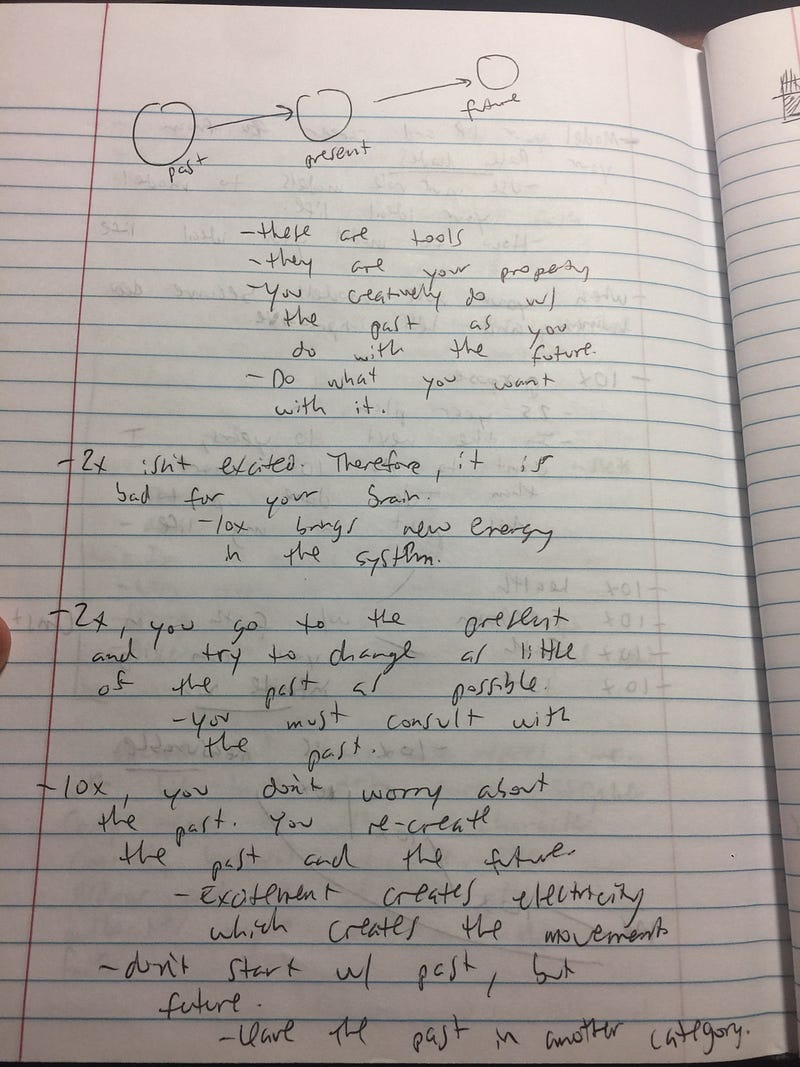
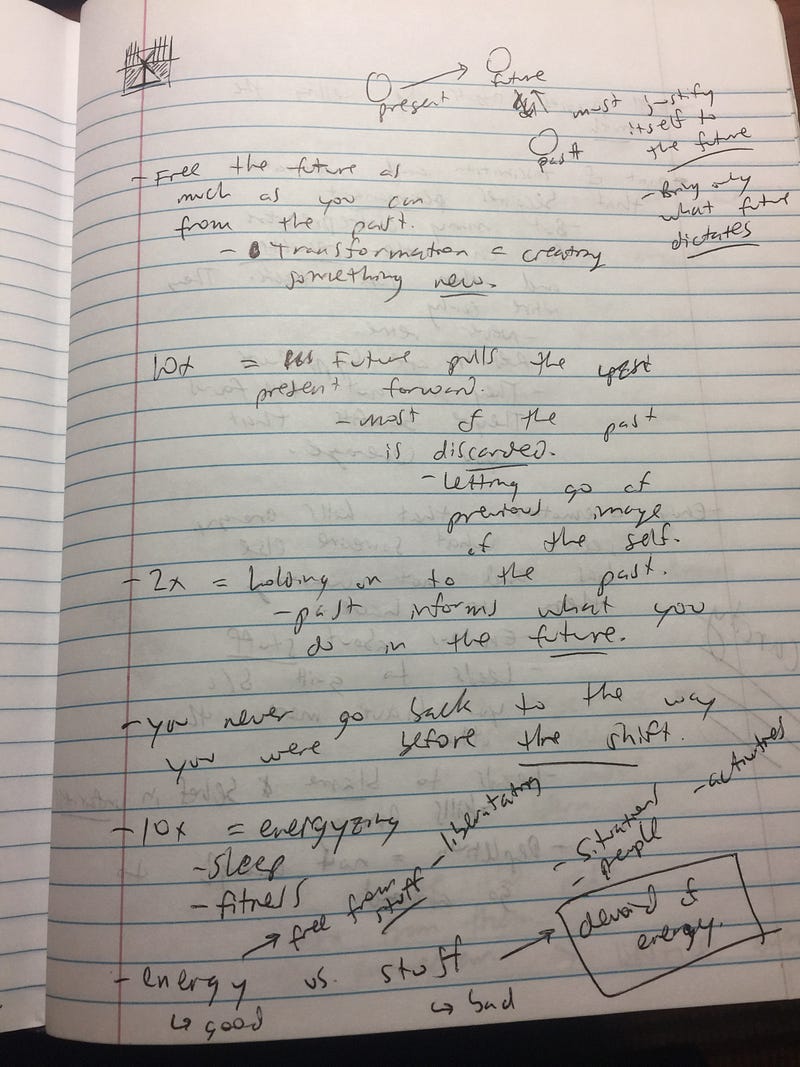
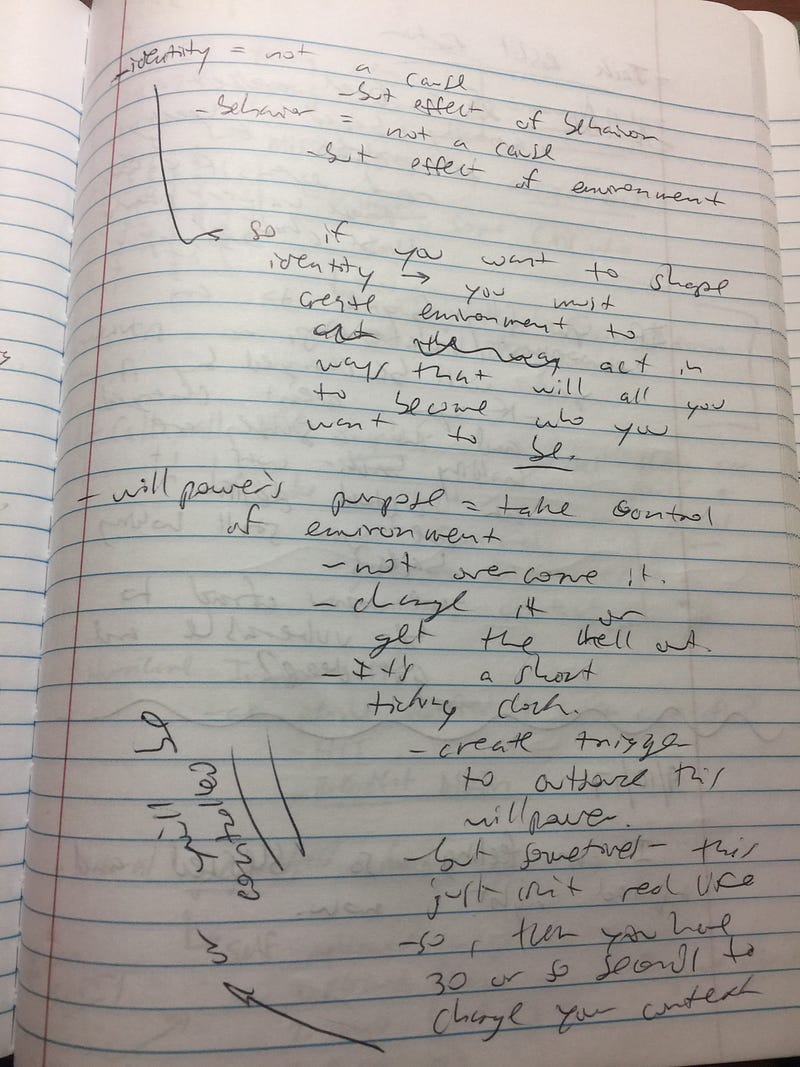
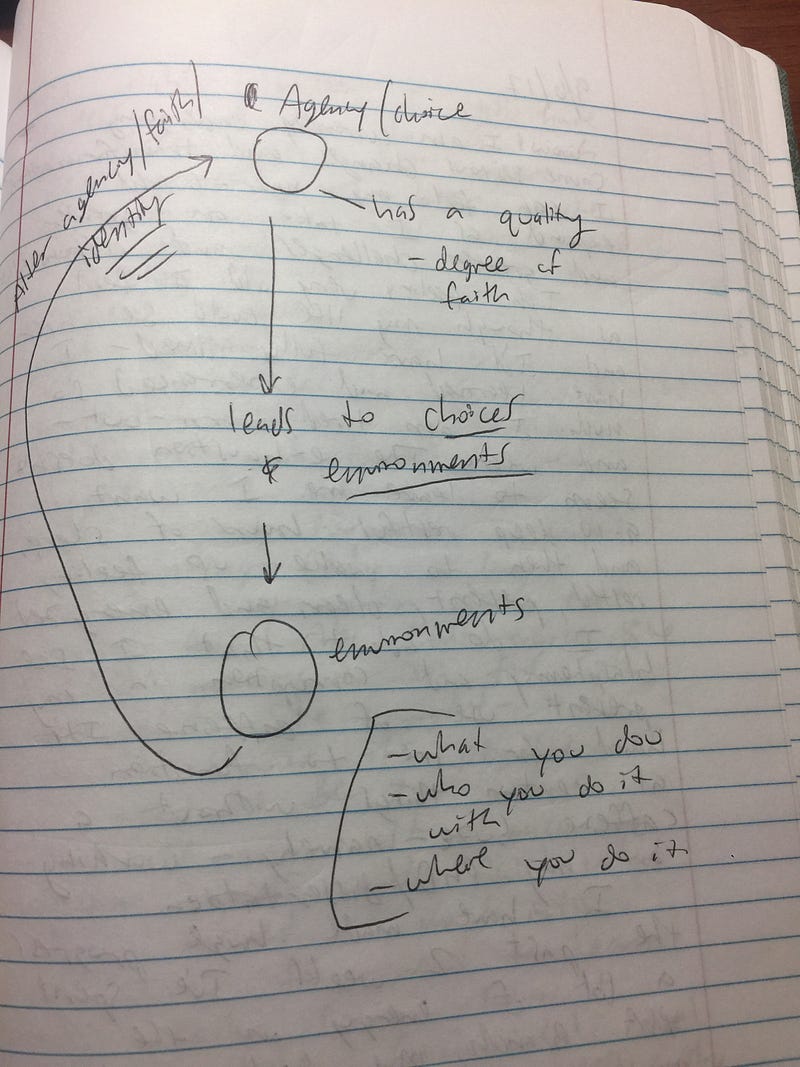
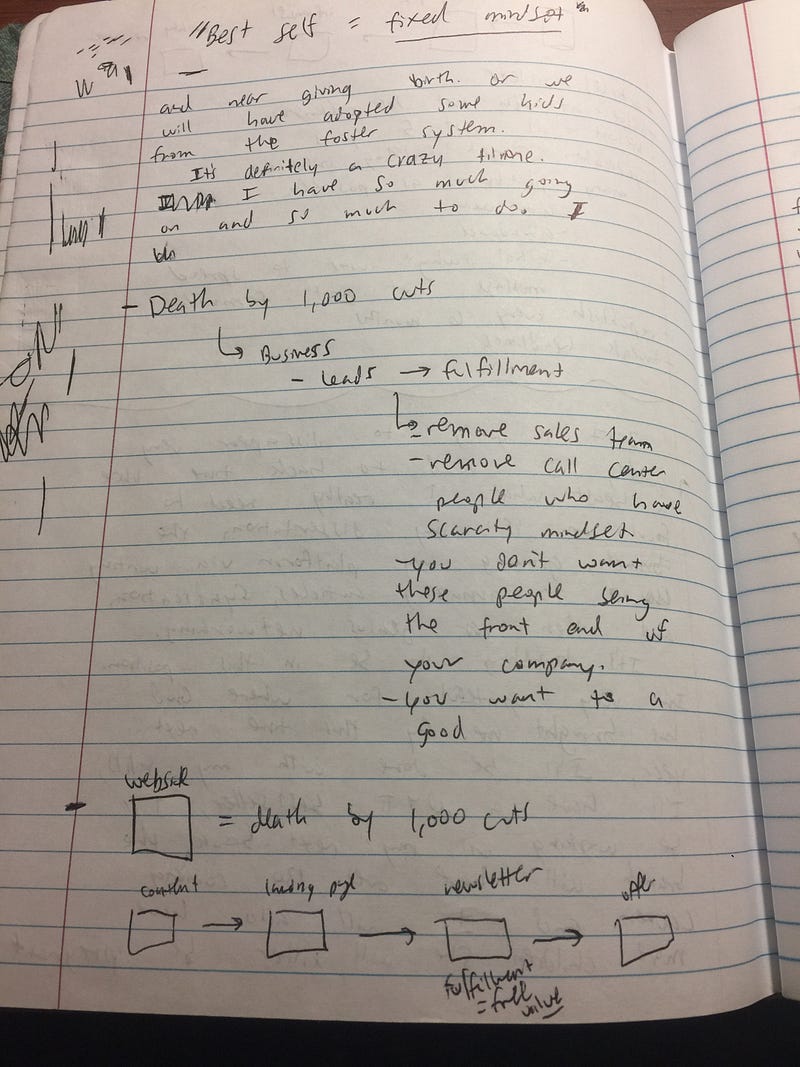
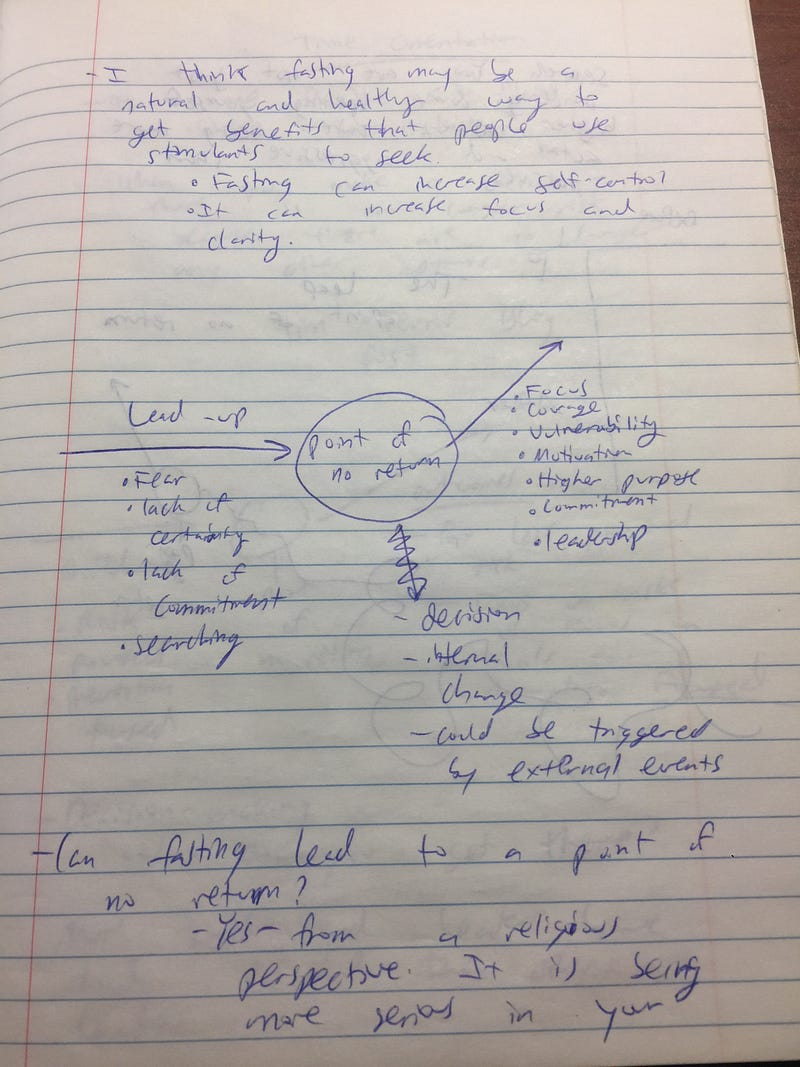
Below are images from my own journals related specifically to my goals. Some are from more recently, and I threw an oldie in from early 2016. The purpose of showing you these images is not to focus on the content of my journaling or goals, but to focus on the continual process of using your journal to frame and achieve your goals.

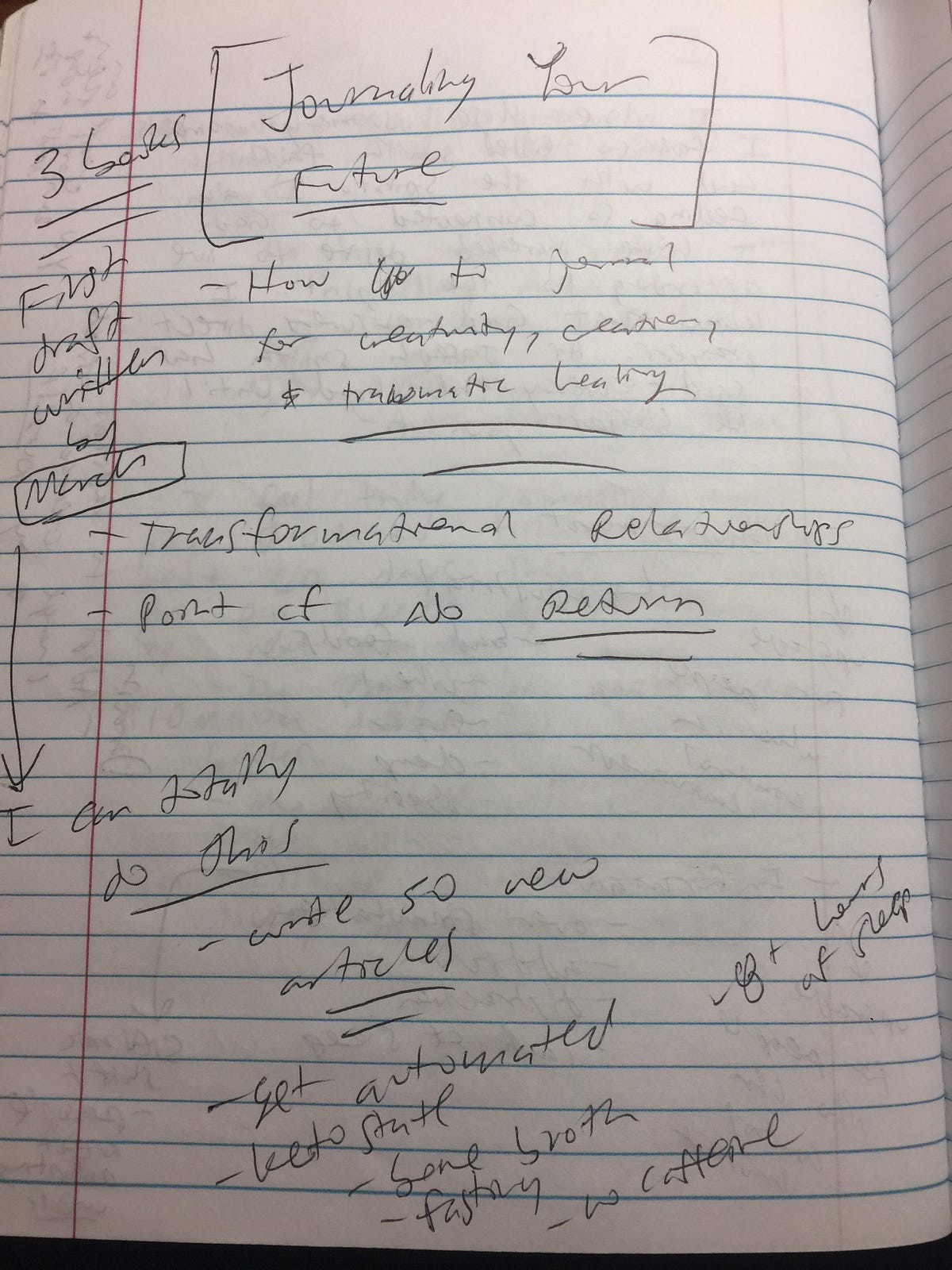
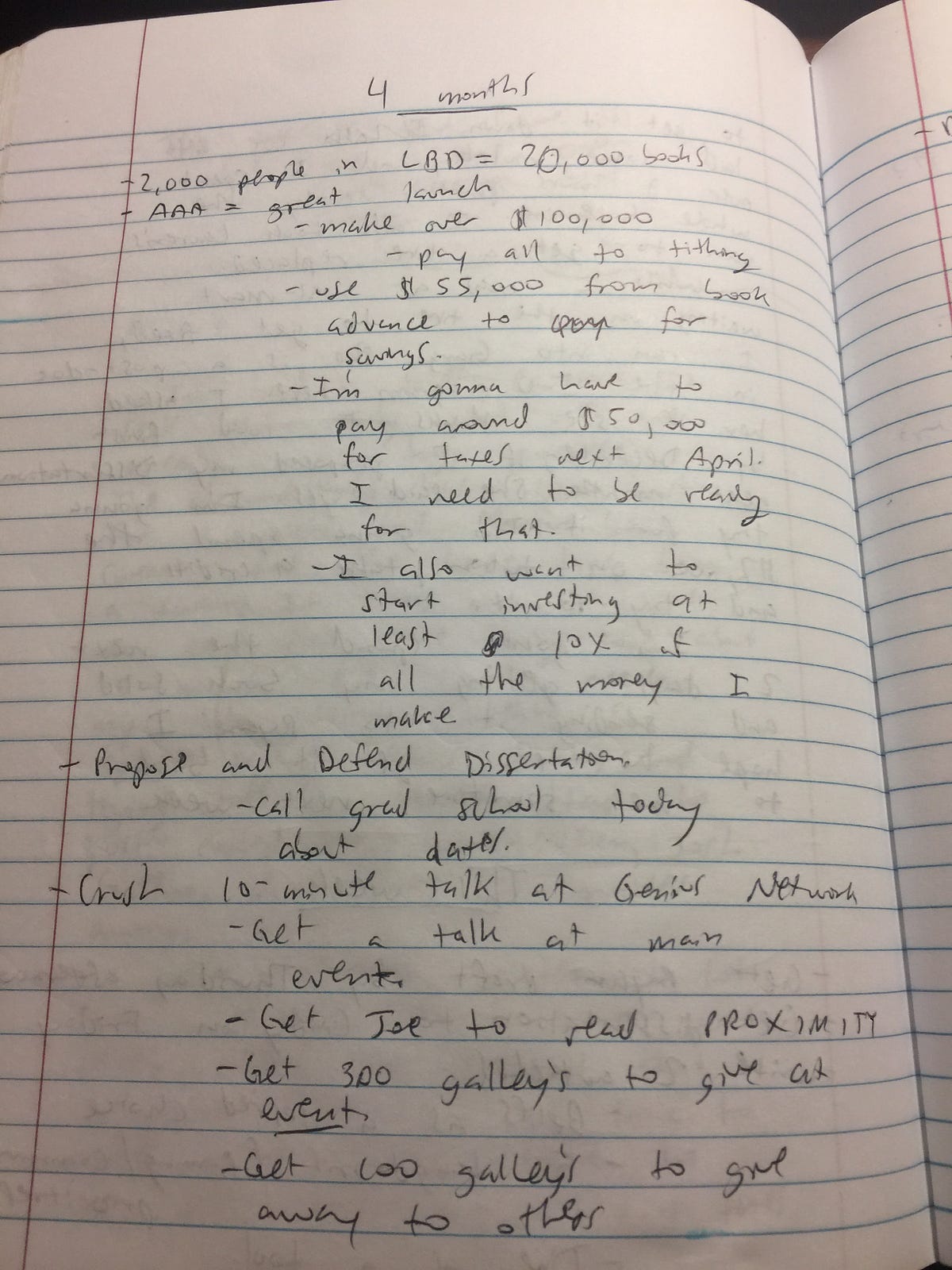



It's effective to have a condensed or similar version of this recovery journaling session during a weekly planning session. Every week, it's important to reflect on your previous week, and to make better plans for the following week.


Weekly planning sessions are essentially an expanded version of your morning journaling ritual, which will be detailed below.


Specifically, in your weekly planning session--which should happen in your journal, you can write about the following things:


  • How your previous week went (the good, the bad, etc.)

  • What you did well (your "wins")

  • What didn't go well (what you didn't do, who you didn't reach out to, where you fell short)

  • Record any significant events (like great moments with a friend, family, or a breakthrough in your work)

  • What your plans are for the following week

  • How you intend to take what you learned from your previous week and do better next week

  • Write down your bigger picture goals (in a short bullet-point list as a reminder of your "why" and "end" goals)

  • Write your proximal goals (things you're immediately working toward over the next 1-6 months)

  • Write specific to-do's you must do the following week (including plans regarding your morning routine, learning, relationships, work, fitness, etc.)


Your Morning Journaling Ritual to Get Yourself Into a Peak State, Daily


Every big decision you make should be done while in a peak state. Decisions are things you're truly committed to. One of the most effective ways to get into a peak state is by leaving your routine and environment. You need some time to disconnect and reset.


During this recovery session, it's key to not browse the internet, social media or email. It's good to have your phone with you, but only to act upon insightsyou get while writing in your journal, while listening/reading a book, or while pondering/reflecting.


Often, you'll get insights about key people in your life. You should immediately make communication of some sort with the people who come to mind-- whether that means sending them an email or text, or giving them a phone call. Recently while writing in my journal, I got the insight to send flowers to some people who have recently helped me. I immediately pulled out my phone and ordered flowers to their address. Then I continued my journaling.


The remainder of this article focuses on your daily morning journal session. Most people start their day in a reactive way. The first thing they do is look at their smartphone and immediately get sucked into a digital world of other people's information and agendas. They've set themselves up to live the remainder of their day in a distracted and reactive manner.


Having a morning routine is important for a few key reasons:


  • To reconnect deeply with yourself and your why

  • To put yourself into a peak state, such that you can achieve the dreams and vision you're seeking in your life

  • To frame yourself for what you really want to do that day

  • To live proactively, not reactively, so that you avoid self-sabatoge


A morning routine can entail many different things, such as fitness, meditation, prayer, working on a creative project, etc.


All of those things are incredible. However, there is one thing I believe to be the most essential in the morning: writing in your journal. Writing in your journal is more powerful than simple meditation for the same reason that writing your goals down is more powerful than leaving them in your head.


Meditation and prayer are powerful ways to make your journaling session more effective. However, meditation, prayer, and visualization in and of themselves are not enough. You need to write down the insights, plans, and goals you have. And you need to write them down daily.


Meditation, visualization, prayer, and journaling are all powerful activities that go very well together. But the journaling portion is where you solidify, clarify, affirm, and strategize your insights, goals, and plans.


Journaling makes the other keystone activities 10X or 100X more powerful. If you're not using your journal daily, then your meditation, visualization, and prayer will be far, far less effective.


The key purpose of a morning routine is to put first things first. To focus on the important stuff in your life, rather than the urgent. The goal is to put yourself into a peak state so you can then operate from that state in all you do, every single day. This is how you get out of survival mode and get massive momentum in you life. Momentum leads to confidence, which then leads to bigger and bigger dreams, better service and value you can provide, and a more congruent life.


Thus, fitness and creative projects are great morning activities. However, nothing should come before priming yourself into the state of being you plan to operate from for that day. Here's where meditation and journaling come in.


Your conscious and subconscious mind, as well as your creative brain and energy levels, are in the optimal condition immediately following sleep.


Writing in your journal first thing in the morning is essential for training your subconscious mind to achieve your goals. As Napoleon Hill wrote in Think and Grow Rich, "The subconscious mind will translate into its physical equivalent, by the most direct and practical method available."


This morning journaling session only needs to be 5-15 minutes.


When you write your goals and dreams down first thing every morning, you deepen your own sense of belief and desire in your goals. If you don't believe you can achieve your goals, you won't. If you don't really want to achieve a certain goal, it probably won't happen.


So, every morning, you need to put yourself into a place where you're reminded of it, you believe it, and you want it badly. As a result, you'll work hard that day, and every day, to not be distracted nor derailed from what really matters to you.


It's also powerful to write your goals in an affirmative and definitive way. For example, if you want to make $100,000 or run a marathon, write:


  • I'll be making $100,000 by [date]

  • I'll run a marathon by [date]


Write your goals down down daily. Then, in your morning mental state, you should write down everything you need to do to achieve your goal. This includes people you'll reach out to. It includes things you'll do this week, and even this day related to that thing. Here are some examples from my own journal:
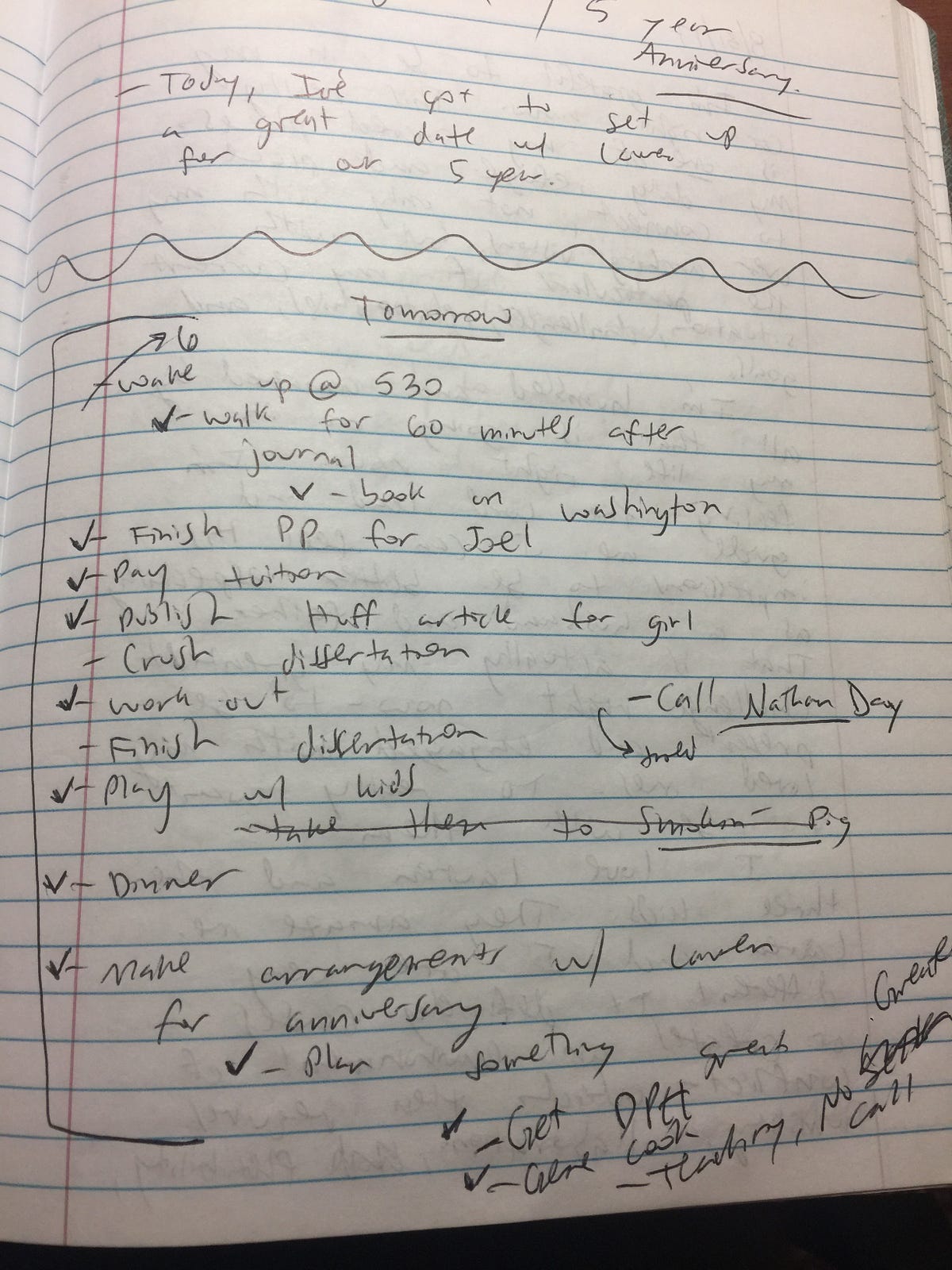
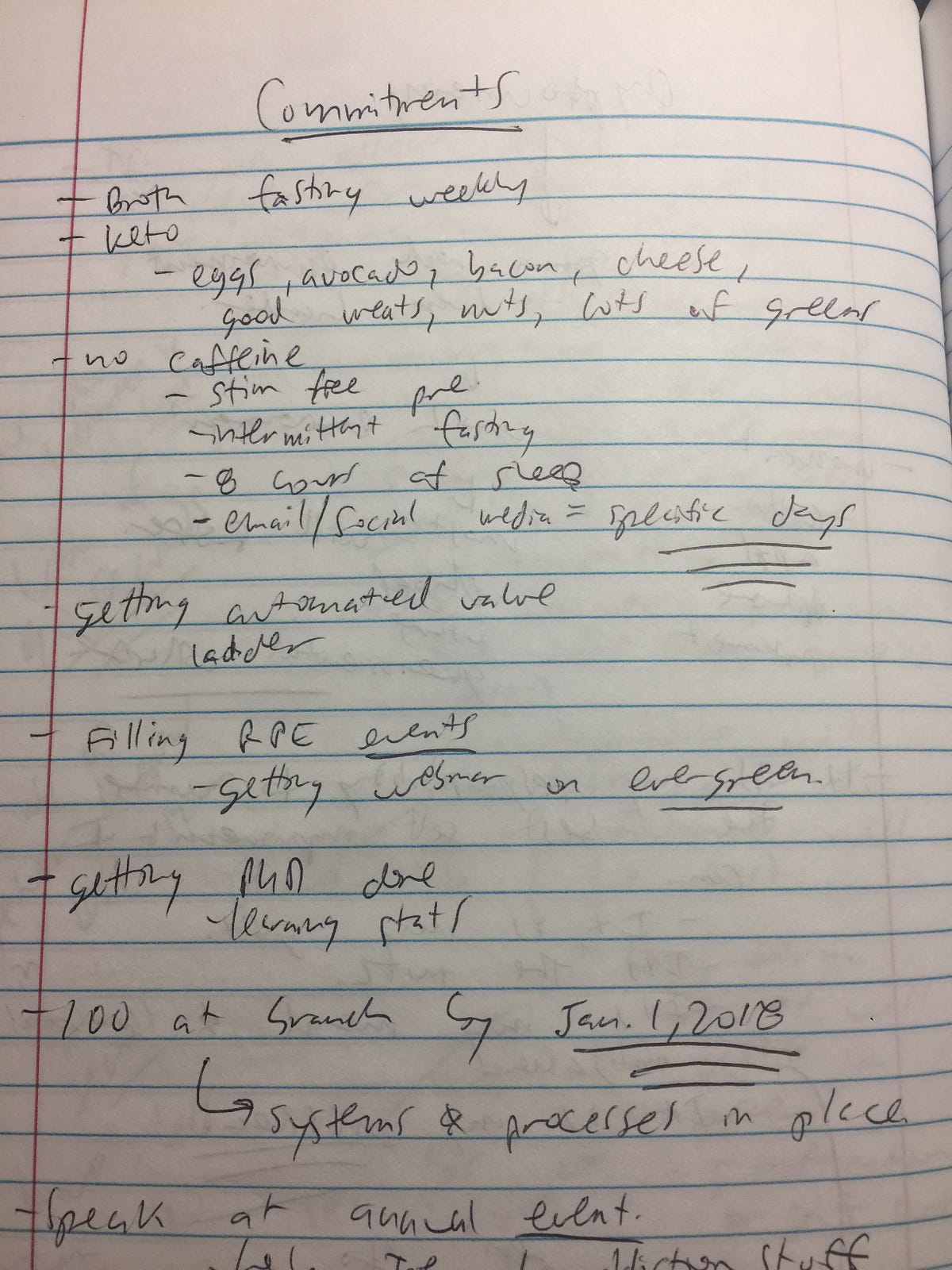


The image above on the left actually shows the planning session I had the night prior. Consequently, during my morning routine, I usually briefly review and revise my plans made the evening before.


Another thing you can do in your morning journal session is write about the ideas you have. For example, it's during this 15 minute journal session, usually right before I go into the gym, that I write down ideas for articles I want to write. Your brain is very creative first thing the morning. Your energy levels are also very high, especially if you don't immediately plug into your email or social media.


If you're trying to do creative work, or really any work in general, it's very effective to write ideas or plans down first thing in the morning. You'll get amazing insights that will make the actual work you need to do so much easier.


As it relates to my own writing, I can spend a few minutes sketching articles ideas in my journal, which then makes writing an actual article 100X faster and easier. Once I sit down to write, the main thinking and framework are done. All I need to do is open my journal, remind myself, and then write.


Here's some examples of my journal ramblings as they relate to ideas and things I'm working on or thinking about.


Conclusion


Your journal is your most powerful resource for manifesting your dreams. Writing in your journal compounds and deepens the essential activities of meditation, visualization, and prayer.


If you're serious about achieving specific and big things in your life, you need to put yourself into a peak state and make a firm decision from that state. Usually, that will require getting out of your normal, day-to-day routine, where you can get clarity.


However, making that "decision" isn't enough. You then need a routinized and daily way of triggering yourself back into a peak state. You need to daily operate at the level of your decision if your decision will become a reality.


Every morning, you can use your journal to prime yourself into the person you need to be--that day, and every day--in order to make your dreams a reality.


You do this by writing your goals and dreams down in the affirmative every single day. You then write down all the ideas, thoughts, plans, and strategies that come to your mind about what you need to do in order to achieve those goals. You write down the distractions you need to remove from your life that are stopping you from getting where you need to go.


You also use your morning journal for ideation and creation. Your brain is very creative and your subconscious mind is very susceptible first thing in the morning. While writing about your ideas, you'll get a ton of creative breakthroughs that will enable you to do amazing work.

The post How I Use My Journal To Create My Future and Achieve My Goals appeared first on inc-asean.com.


[ad_2]
no image

Building Zapier Through Action, Not Perfection

[ad_1]


PHOTO CREDIT: Getty Images


Struggling entrepreneurs face many challenges as they try to bootstrap their way to success, but analysis paralysis may be one of the biggest hurdles stopping them from reaching their goals and keeping them in the cycle of trying to launch. Some entrepreneurs may think that if they can just learn more, success will come. But unfortunately, reading more books and blog posts alone isn't going to be enough to move business forward.


So what will? I recently sat down with Zapier Co-founder and CEO Wade Foster to find out his take on the subject. While he definitely believes lifelong learning is an important factor, in his opinion, it's taking action that is a direct pathway to success. It's how he built Zapier, a web automation platform that now integrates with over 900 different web apps, from Slack to Mailchimp and Salesforce.


Wade says he sees too many entrepreneurs hesitating and trying to achieve perfection before taking action. Instead, he encourages entrepreneurs to start working now to gain the experience they need. "They want to be perfect out of the gate, and they delay actually working on their thing by going to read more blog posts," he says. "'They say, 'I don't know everything quite yet.' They wait too long. Instead, it's better to just start working."


Default to Action


Like Wade, I have never subscribed to the idea that launching perfectly is necessary - the idea is just to launch.


One of Wade's favorite anecdotes is from the book Art & Fear, by David Bayles and Ted Orland. The book describes how, on the first day of a pottery class, a ceramics teacher divided students into two groups. The teacher told half of the students they would be graded on how good their pottery was, and the other half on how much pottery they made. At the end of the class, it was revealed that the group that produced the most pottery also produced the best pottery.


"By just getting down to business and trying to make as much pottery as possible, those people actually did the work and over time were able to slowly perfect their process for making it," Wade explains. "They actually had better pottery than the quality group, which focused so hard at the beginning on doing it perfectly right out of the gate, that they never got around to actually getting good at the task."


Don't wait, he advises. Instead, "Default to action. Don't worry so much about perfection or failure. Over time, by doing it, you'll get better at it."


It's just common sense that the harder and more deliberately you work and repeat the process, the better you'll get. But you also need a learning component that incorporates leaning on the success of others.


Work with Experts to Stay Ahead


One of the best ways to do this is to ask for help from those who have done it before you. Wade likens it to his experience with trying to get into shape by taking up racquetball. When an older man from his gym offered to play with him and share some tips, Wade assumed he would "out-athlete" him, even though he knew nothing about racquetball. Instead, the man beat him 11 to nothing in less than ten minutes.


"I was like, 'Wow, I have a lot to learn here,'" Wade recalls. He jumped at the man's offer to help him learn the sport, and they did drills together 30 minutes a week. Wade's now been at it for nearly 18 months and has a pretty decent racquetball game. He credits his improvement to two things: coaching and repetition.


Wade didn't think about waiting to start racquetball until he knew enough to get started. He just learned the sport as he went. Take the same approach with your business: go straight to the experts and reach out to them for advice. That's what Wade has done at Zapier, and that's how I've built many of my own companies from scratch, including content marketing agencies and SaaS companies like Mailshake. When I started, I didn't know everything about building a SaaS and what to do next. So I asked an expert for help, then just dove in and started doing it.


Cold Email Others for Advice


One of the best ways to reach out to experts is through cold email. Simply contacting people and asking for advice or for their help is effective - just get really specific with your request, and respect recipients' time.


Wade regularly reaches out by email and asks experts for very specific advice and insights. Wade estimates that Zapier changes and grows its customer base about every 6 months, so he sends cold emails to CEOs who are ahead of Zapier in terms of their business size and success. He asks them:


  • What was the biggest mistake you made in the last year?

  • What is the best decision you made in the last year?


And because these companies are a year or two ahead of Zapier, their knowledge and experience is incredibly fresh. "It helps me keep an eye around the corner of what's coming next," Wade says.


Embrace Lifelong Learning and Adaptability


As much as Wade emphasizes diving in and just doing things as opposed to simply learning about them, he definitely embraces lifelong learning and adaptability as integral parts of the entrepreneurship journey. As Zapier constantly evolves, so does Wade. He says there's a constant need to re-adapt his entire approach to running the company as his customer base grows and changes.


"As we get more customers, we have to change the way we approach and serve them," he says. "As a result, we have to start thinking, 'How does our organization change to support that size of a customer base?' Adjust the role you play in the organization to help it grow.


"You need to be able to build a skillset that will allow you to pick up on new skills, tricks, tactics, and strategies relatively quickly. And this never stops, especially if you're a growing company like Zapier is. If you don't get good at this learning and development thing, you're really going to struggle to grow and scale as an entrepreneur."


Experience is Everything


At the end of the day, entrepreneurship is about action and learning; experience counts for everything. You can keep waiting to perfect your launch and learn more about the business you're trying to create, or you can dive in, gain experience as you go, and build your own success.


The question is: are you going to take action, or keep waiting for just the right time?


How have you used Wade's tactics to grow your own business? Are you a lifelong learner? Do you regularly cold email CEOs and experts for advice? Let me know by leaving a comment below:

The post Building Zapier Through Action, Not Perfection appeared first on inc-asean.com.


[ad_2]

Friday, September 22, 2017

no image

There Are 100 Days Left in 2017. Here’s How to Achieve Your Most Important Goal Before the Year Ends

[ad_1]


PHOTO CREDIT: Getty Images


There are 100 days left in in the year. How are your 2017 goals coming along?


For most people (me among them), there are things you wanted to accomplish that you haven't even started yet. Fortunately, 100 days is a great time period for achieving goals. It's a sufficient block to achieve progress, but short enough to leave no room for procrastination, which leads to a greater likelihood of success.


I know this from experience, having used 100-day plans several times to achieve big professional and personal goals. Among them:


  1. Getting in shape to run a marathon, after basically being a non-runner.

  2. More than quadrupling the average monthly readership of this column, from about 250,000 people to well over 1 million.

  3. Studying for and successfully passing the state bar exam, while simultaneously running a media startup.


Below, I'll explain my process for mapping out a successful 100-day plan. The planning process likely takes between 30 and 60 minutes to complete. Implementation is then up to you.


1. Draft a goal.


You need a goal, obviously, and steps 1 and 2 of this process are about choosing the right one. To be more specific, you need on objective that is worthwhile, quantifiable, and at least arguably achievable.


  • Worthwhile: We'll discuss this more below in #2, but there's nothing worse than working hard for something that doesn't merit your time and energy.

  • Quantifiable: No wishy-washy goals allowed. To use the example of wanting to train to run a marathon in 100 days, it's not enough to say, "I want to get in better physical shape." Instead, you need something you can measure--26.2 miles. Otherwise, how will you truly know if you've succeeded?

  • Arguably achievable: If your goal isn't a bit of a stretch, you probably don't need a 100-day mapping plan to begin with. But at the same time, you don't want to set yourself up for something you'll never have a chance of reaching.


2. Question the goal.


A wise man once said, ""It's better to be at the bottom of a ladder you want to climb, then halfway up one that you don't."


To avoid getting on the wrong ladder, you need to ask yourself "why" at least three times while you're setting your objective. As in, "Why do you want to achieve this particular goal?"


After you answer that question, you'll need to ask it again, and preferably once more. Each time, it's likely your will reveal a larger goal. For example:


  • Why run a marathon? Because it's a challenge and because 26.2 miles is a marker that will demonstrate that I'll be in better physical shape.

  • Why do you want to get into better physical shape? For my overall health.

  • Why are you concerned about your overall health? Because I want to live as long as I can and spend as much time on this planet with my family as I can.


Those sound like three good "why questions" to me. The point is to ensure that whatever you're going to spend 100 days trying to accomplish will ultimately help you achieve a higher purpose. Otherwise, what's the point?


3. Map the milestones.


You have a goal. You have 100 days. Now you need to start to map it out. You can divide these any way you like, but I find it most useful to divide everything into three 30-day increments, followed by a 10-day final increment.


Assuming you're reading this article on the day it was published therefore, this gives you four milestone dates before the end of the year: October 22, November 21, December 21, and December 31.


Then, work backward, as if you wanted to achieve the final milestone--the full marathon, for example--on the 90th day, December 21. The last 10 days will either be a cushion, a time to push past your goal, or a celebration, depending on how successful you are.


I'm still old school enough to like using a large, printed calendar to record these dates and objectives, but a digital one can work as well.


4. Schedule the inputs.


You now have a 100-day calendar with four milestones marked. Next, you need to fill in the remaining 96 days, with the specific things you believe you will need to do to achieve the milestones.


Each day should be filled in, even if--for example in the case of a marathon training plan--there might well be days on which your daily input is: Nothing. Rest. Take a day off.


Unless you're far better at planning than I am, I'd use pencil (or use a digital calendar). You'll likely wind up revising many of the days' tasks and inputs as you proceed. And that's okay.


Literally, this is a marathon, not a sprint. It also doesn't matter greatly if in putting together your inputs, you realize that you will need a bit longer than the 100 days to achieve your goal. You'll still have a lot of reason to be proud if you need a few extra weeks, and if you wind up celebrating your success on January 21, for example.


5. Track the outputs.


Now we move from planning to actually doing--and it's super important also to track your progress each day.


If you were supposed to run five miles yesterday, did you? If you were supposed to cold-call 20 potential widget customers, did you make the calls? And if you didn't meet your daily goal, how does that shortfall affect your daily goals for the next few days?


Do you need to adjust them to make up?


Or have you overachieved already, and thus bought yourself a little bit of extra time? (This is why we write the daily inputs in pencil; few people can get through the entire plan without adjusting it here and there.)


Tracking may well involve letting others know about your goals and inviting them to hold you accountable. For example, when I was training to run a marathon, I did so with a group of other aspiring runners. When I was working to find more readers for this column, I checked in with my editors.


This is also the reason why you want that extra 10 day cushion at the end. By banking 10 percent of your 100 days, you significantly increase the odds that you'll achieve the final goal on time.


Let me be the first to congratulate you!


I find this plan to be simple, but not necessarily easy. However, it's worked for me multiple times--including one I didn't mention before: The just-over-100 days that elapsed between the time my then-future wife and I got together, and when I convinced her to say "yes" when I asked her to marry me.


Thus, I'm a firm believer, and I hope it works for you as well.


What are your remaining goals for 2017, and how do you plan to accomplish them? Let us know in the comments below.

The post There Are 100 Days Left in 2017. Here’s How to Achieve Your Most Important Goal Before the Year Ends appeared first on inc-asean.com.


[ad_2]

Thursday, September 21, 2017

no image

Top 3 Ways to Market Your Asian Start-up in the Age of Authenticity

[ad_1]


PHOTO CREDIT: Getty Images


Consumers are more discerning than ever. This is driven, in part, by social media platforms that make testing and reviewing brands seamless. It's also a result of brands working harder at making real connections with their customers through social media and other channels. As consumers become accustomed to brands reaching out, making personal connections, and sharing bespoke content, the expectations keep getting higher.


As a result, businesses are scrambling to keep up with consumer expectations for "authenticity" in brand experiences. Like any buzzword, authenticity can mean a lot of things, but when it comes to branding, it generally refers to how well a business connects with real people through effective content marketing. Put differently, do people consider the brand to be honest and engaging.


According to research by Bonfire Marketing, 91% of consumers say they expect brands to be authentic in their communication, particularly on social media. Add that to the fact that 63% of respondents indicated that they'd be more likely to engage with a brand they deemed to be authentic, and it's clear why companies need to rethink their content strategies. The following are some of the fastest and best ways to start marketing your brand authentically.


Authentic Imagery


Visual branding is critical in today's social media driven landscape. Instagram and similar applications have elevated demand for high-quality images to show how products and services fit with consumer lifestyles. Matt Munson, CEO of Twenty20, an authenticity-driven stock photo platform, explains, "Visual storytelling has become a powerful mechanism to help brands create lasting connections with their audience. It's compelling imagery and content that when paired together successfully, invites people into the conversation and creates that bond."


The trouble is, most brands don't have the time to commit to photo shoots and bespoke visual content creation. To make matters worse, stock photo giants primarily offer images that feel manufactured. Munson explains the problem with that approach, "As visual creatures, we connect with imagery that feels authentic and real. Traditional stock photography, while convenient to use, lacks the real human connection smart brands are looking for."


That desire for authentic imagery is giving rise to stock photo services that offer images that feel more like something you'd see on Instagram. Whether you have an in house visuals team, or leverage stock photos, it's critical to make sure that the images you choose to represent the brand have a more human touch.


Authentic Storytelling


Back in the day brands could get away with blatant product placement or invasive advertising, but in today's increasingly social landscape, such attempts to sell without relationship building will be met with skepticism and even scorn. In fact, Elite Daily research found that only 1% of millennial consumers think that compelling ads increase their trust in a company. This is further evidence that organizations that fail to humanize their messaging won't gain much traction with consumers in channels that require storytelling.


It helps to look at brands that have been successful at using content to connect with consumers. GoPro set an example for how to crowdsource content to tell stories and grow a brand. Instead of trying to tell one brand story, the camera maker gathered and elevated its customers' varied interests and hobbies and let each of them tell their own story with the product. Years after their launch, over 6,000 videos are uploaded and tagged #GoPro every day. While not every brand can rely on their customers to create content, every company should be telling stories that create real connections with their customers.


Authentic Influencers


Everyone knows that influencers are an important part of any brand's marketing strategy, but getting authentic influencer engagement is even more important. See Pepsi's recent mishap with "influencer" Kendall Jenner. As people search for honest brands, celebrity endorsements or obvious paid influencer support won't help marketing efforts.


Instead, companies need to partner with influencers and let them honestly engage with the brand in their own voice. The benefit behind working with established influencers is that they have an audience that looks to them for recommendations, insights, and relevant content. The last thing any brand should do is subvert that connection with their audience by controlling the messaging. When people see an influencer authentically sharing a brand, they are much more likely to do the same. Whether a company makes connections with influencers or works closely with an agency, the focus must remain on letting those influencers experience and share the brand on their terms.


Authenticity Takes Time


It's important to note that in most cases being transparent, vulnerable, and authentic represents a significant time investment for any business. Particularly those that don't have teams dedicated to developing new brand assets. This is why it's critical to leverage tools and resources that deliver on authentic branding so you can focus on the parts that simply can't be streamlined, like personal connections on social media, or effective storytelling.


A word to the wise, don't tout being an authentic brand without putting in the requisite effort. Doing so may cause consumers to start sharing where your brand falls short with their friends, and worse, on social media platforms. If you make sure you're doing everything possible to show that your company is authentic, you probably won't even need to say it.


With the number of channels through which customers can be reached growing rapidly, it's important for brands to be omnipresent without losing their soul. As Munson puts it, "As consumers, we're overwhelmed by choice and communications. I want to be invited into a brand experience. I want to be invited into a mission or a lifestyle." Companies that entice their consumers into something meaningful stand to gain customer share, in a market that depends more and more on consumer perception and authentic brand experiences.

The post Top 3 Ways to Market Your Asian Start-up in the Age of Authenticity appeared first on inc-asean.com.


[ad_2]

Wednesday, September 20, 2017

no image

“I Would Outsource Brushing My Teeth if I Could”

[ad_1]


PHOTO CREDIT: Getty Images


Brad Stevens is an Entrepreneurs' Organization (EO) member from Atlanta, Chair of the chapter's EO Accelerator program, author, speaker, career entrepreneur and founder and CEO of Entreholic, which helps companies identify and implement innovative growth and execution strategies. We asked Brad how entrepreneurs can leverage outsourcing to achieve growth. Here's what he shared.


There is a seismic shift happening in the workforce and only a minority of CEOs and entrepreneurs seem to be aware of it. The most innovative companies are already experiencing substantial benefits as the role of the W2 employee is changing rapidly.


In today's hyper-competitive business landscape, getting things done faster and cheaper could mean the difference between turning a profit or going belly up. Entrepreneurs and small business owners have no choice but to shift from a "Do it how it has always been done" mentality to one that asks, "How can we work smarter, not harder?" We must adapt to a much more flexible, almost on-demand structure to get everything done within budget.


My entrepreneurial journey is a true testament to this movement. In my last business venture, I found myself in a tough spot: Money was extremely tight, and we encountered significant product challenges. In order to pull it together and grow, I had to stretch my dollars further. I had to accomplish essential business tasks while still driving marketing and sales. My stress level was through the roof, but the only way I knew to make it work was to put in even longer hours.


When I met with a colleague who opened my eyes to the wonders of outsourcing, I was blown away. He showed me how to get innovative marketing and sales projects done for pennies on the dollar. What I, and most business owners, thought would cost thousands of dollars, he was doing for a few hundred dollarsor less! I couldn't get home fast enough to figure out how to replicate his results. After five hours of research, I discovered a whole new world that would change my trajectory as an entrepreneur. It also dramatically changed how I execute in my personal life.


I realized the opportunities for efficiency and speed coupled with monetary savings are substantial. It's not just about low cost. It's about velocity of execution, getting work done two or three times as fast. With online platforms, you have instant access to millions of low-cost and highly talented firms, contractors and freelancers from around the world. With no overhead or marketing expense, they perform incredible work at unbelievably low prices. The "instant gig" economy of virtual on-demand workers is revolutionizing how businesses can and will operate.


Through outsourcing, I got more than US$10,000 worth of marketing and sales services for US$500, propelling my company forward almost overnight. I began outsourcing almost every aspect of my businesswebsite development, telemarketing, graphic design, lead generationyou name it. Not only was I getting more done for less, but I had more time to focus on growing our operations. Soon I was even using creative growth hacking strategies like data scraping and data mining, two of the most powerful concepts I discovered, to grow my business at a very low cost. Such strategies enable you to create highly-targeted lead lists for pennies on the dollar.


And it's not just marketing and sales. Even work such as Autocad drawings, financial modeling, recruiting, data management and 3D renderings are being done for a fraction of the cost and twice as fast.


And it's not just international. Many of the firms and contractors are in the U.S. where talented executives with corporate backgrounds can now earn just as much if not more working from home on their terms.


In just a few months, our business was back on track, and I continued to build my skills. When I asked around, I was surprised to find that only 10% of entrepreneurs and business owners knew these freelance platforms and unique tools even existed. I knew this information would be the basis of my next business, where we would share our "addiction" to entrepreneurship and lean growth using these techniques. Over the past four years, as I have worked with business owners, I am always asked the same question: "How can we get started with outsourcing?"


Here are three tips that I share with my clients:


  1. The key to growing a successful business is to find an advantage and exploit it before your competition does. Typically, businesses run from the inside out: Most work is done internally and a few specialized projects are outsourced to freelancers. However, running your business from the outside in can save you money and increase productivity overnight. Outsourcing or automating repetitive tasks can free up time to build other critical components of your business. Outsourcing is a booming industry, even inside the U.S.: Forbes estimates that by 2020, 50% of American workers will be freelancersmaking getting work done easier, cheaper and faster.

  2. Build a virtual team with a broad range of skills. Whether you need a website developer, graphic designer, content writer or marketing manager, it's important to assemble a team of freelancers. Identifying tasks that are major time or money drains and outsourcing them can be the most effective use of your resources. Also, having an experienced "virtual business manager" to manage your team of freelancers can make outsourcing as seamless as possible. The unfolding business landscape will favor those who use freelancers to keep a leg up on the competition.

  3. Explore online tools to stay ahead of the technology and business curve. Hundreds of new tools hit the market every dayall engineered to make life easier for us. Spending an hour each week trying out one new tool can help you stay on top of the latest assets for business growth. Almost any area of your business can be improved with a tool. For example, Mouseflow tracks how web visitors interact with your website; Bond creates hand-made cards for customers; and Dashlane securely stores a company's logins and passwords so you can safely share them with freelancers and outsourcing teams.


Adopting a "creative mindset" can be your secret weapon in building a stronghold in your industry. When it comes to starting or expanding your business, the sky's the limit. Thinking outside of the box and being willing to try a new strategy goes a long way toward outpacing the competition.

The post “I Would Outsource Brushing My Teeth if I Could” appeared first on inc-asean.com.


[ad_2]